
How HBCUs Plant Seeds of Black Self-Love
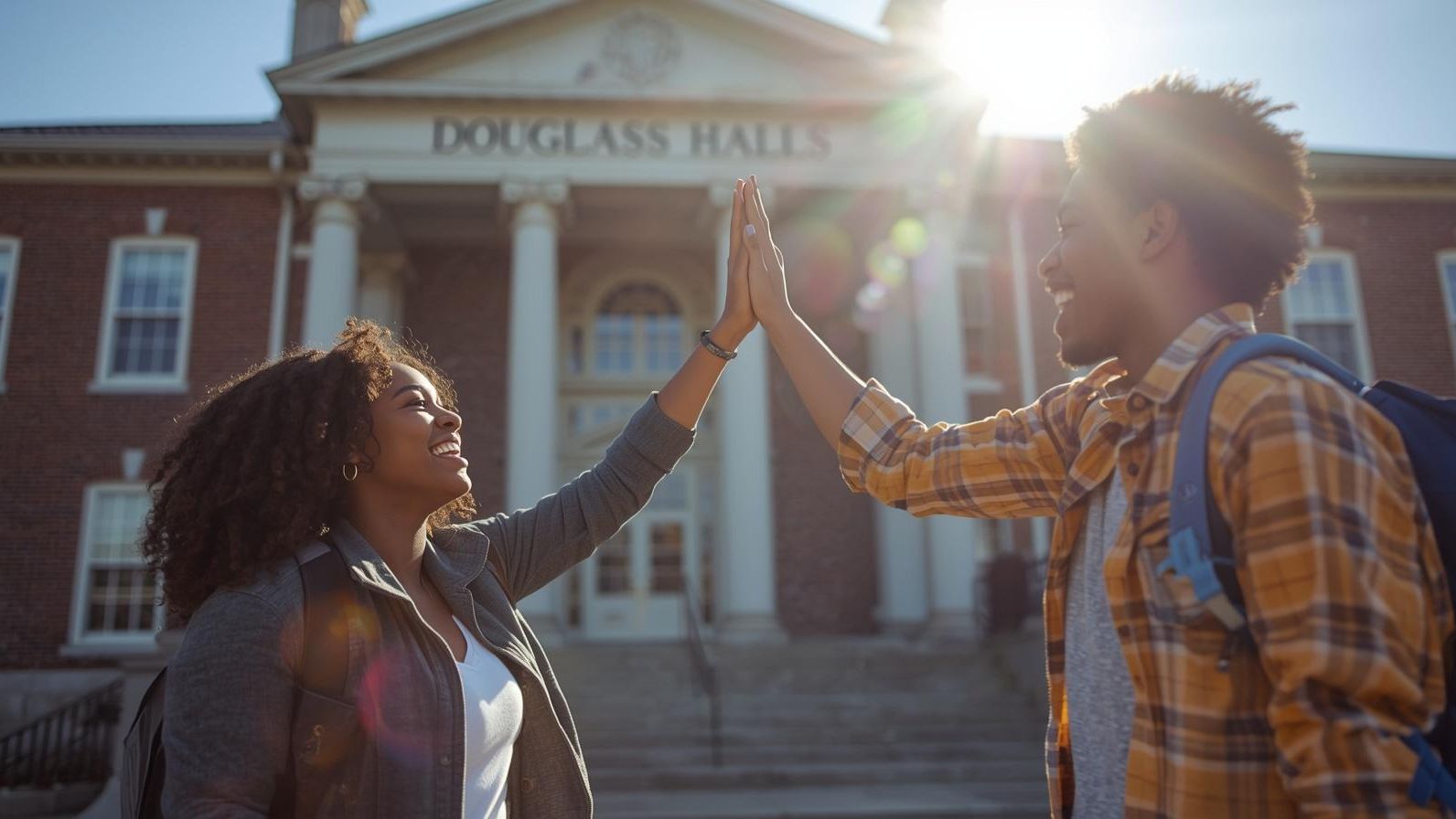
There is a moment that happens on almost every Historically Black College and University campus, usually within the first few weeks of a student's freshman year. It hits at different times for different people. For some, it is in a lecture hall when a Black professor calls on them by name and actually waits to hear what they have to say. For others, it is in the cafeteria, laughing with strangers who somehow already feel like family. For many, it is during homecoming, surrounded by generations of alumni who came before, all of them proof that this path leads somewhere magnificent.
The moment goes like this: a deep breath. A settling into the bones. A quiet realization that says, Oh. This is what it feels like to be seen. This is what it feels like to belong. This is what it feels like to be expected to win.
That moment is Black self-love arriving. Not as a concept. Not as a hashtag. But as a lived, daily, undeniable experience.
Here is what HBCUs understand that the rest of the world often forgets: Black self-love is not just about how you feel when you look in the mirror. It is about the environments you create, the people you surround yourself with, the history you carry, and the expectations you internalize. HBCUs have been doing this work for nearly two centuries. They are not just colleges. They are machines for producing Black self-love at scale. And the results speak for themselves.
The Professor Who Looks Like Your Future
Let us start in the classroom. Because this is where the first and most powerful shift happens.
At many predominantly white institutions, a Black student might go an entire semester—sometimes an entire degree—without ever having a Black professor in their field. The message, whether intended or not, is subtle but corrosive: People who look like you do not lead in this discipline. People who look like you do not create knowledge. People who look like you are here to learn, not to teach.
At an HBCU, that message does not exist. Instead, a Black student walks into their first chemistry class and sees a Black woman at the front of the room who already has a Ph.D. They walk into their engineering seminar and see a Black man who has patents and publications and projects that change lives. They walk into their English literature course and encounter a Black scholar who has written the book—literally written the book—on James Baldwin or Toni Morrison or Audre Lorde.
This is not representation for the sake of representation. This is evidence. Every Black professor standing at the front of an HBCU classroom is living proof that the thing the student is trying to become is actually possible. They are not a distant figure in a textbook. They are right there. They have office hours. They give advice. They write recommendation letters. They remember your name.
And here is the deeper magic: those professors expect excellence. Not the kind of excellence that requires you to shrink or perform or abandon who you are. But the kind that says, I know what you are capable of because I have seen it before. I have lived it. Now show me what you have got.
When someone who looks like you and understands your journey believes in you, something unlocks. You stop asking Can I do this? and start asking How far can I go? That is Black self-love in action. Not hoping you are enough. Knowing you are. Because someone who has walked the path turned around and said, Come on. Keep climbing. You will get there.
The Belonging That Heals
Now step outside the classroom. Walk across the yard. Sit in the student center. Go to the dining hall. What do you notice?
You notice that everywhere you look, there are Black people being brilliant, being goofy, being tired, being ambitious, being in love, being broken up, being stressed about exams, being elated about acceptances. In other words, being fully, completely, unapologetically human.
This matters more than most people realize. Because for many Black students, coming to an HBCU is the first time in their lives they are not the only one. The first time they are not the representative of their entire race in the room. The first time they can just be a student—with all the messiness, awkwardness, and growth that entails—without also having to carry the weight of being a spokesperson, a defender, or a token.
At an HBCU, you do not have to explain your hair. You do not have to code-switch as if doing so is normal. You do not have to ignore microaggressions or pretend like they do not bother you. You do not have to perform for an audience that is secretly waiting for you to fail. You can just be. And in that simple, profound permission slip, something inside is mage stronger.
The belonging you feel at an HBCU is not abstract. It shows up in the study groups that form organically, the late-night conversations in the dorm, the shared frustration over a difficult assignment, the collective celebration when everyone passes. It shows up in the way older students take younger ones under their wings. In the way alumni come back to mentor and hire and invest. In the way the entire campus feels like a small town where everyone is, somehow related.
This belonging is Black self-love made visible. It is the recognition that your well-being is tied to the well-being of the people around you. That you rise together or you struggle together. That there is no such thing as a solo success story in a community that loves itself.
The Legacy That Carries You
HBCUs are not just places where higher learning occurs. They are living museums of Black intellect, determination, and dogged achievement.
Every HBCU has a story. Most of them were built under circumstances that would have broken lesser people. In the years after the Civil War, when Black people were legally free but socially and economically terrorized, visionary leaders—many of them formerly enslaved—scraped together whatever they could to build institutions of higher learning. They raised money from sharecroppers who had almost nothing. They built buildings with their own hands. They taught in churches and barns and open fields because they had nowhere else to go.
They did this because they understood something fundamental: education is the engine of liberation. And they did it for love. Love of knowledge. Love of improved living conditions. Love of a future they might not live to see but believed in anyway.
When you walk across an HBCU campus today, you are walking on ground that was consecrated by that love. The buildings have names—names of people who gave everything so that you could sit in that lecture hall. The traditions have roots—roots that stretch back to times when just being a Black student was an act of courage.
Learning this history changes you. It is impossible to know what your ancestors sacrificed to build these institutions and not feel a responsibility to honor that sacrifice. It is impossible to understand that you are standing on shoulders that were never meant to hold you up and not stand a little taller yourself.
This is not guilt. It is grounding. It is the knowledge that you are part of something larger than yourself. That your success is not just your own. That you are the current chapter in a long, glorious story of Black achievement. That is Black self-love with historical depth. It is love for yourself that flows directly from love for your ancestors and love for the generations who will come after.
The Expectation of Excellence
Here is perhaps the most powerful thing HBCUs do: they normalize Black success until it becomes not an exception, but an expectation.
At many institutions, Black excellence is treated as a surprise. Oh, look at this remarkable young person who overcame so much. At an HBCU, excellence is the baseline. It is not remarkable that you are smart, capable, and ambitious. It is assumed. The question is not whether you will succeed. The question is how you will use your success to serve.
This expectation seeps into your bones. You stop thinking of yourself as a trailblazer who is defying the odds and start thinking of yourself as a student who has work to do. You stop asking Do I belong here? and start asking What will I build as result of being here? You stop measuring yourself against lowered expectations and start reaching for your actual potential.
And because excellence is normalized, failure becomes a temporary occurrence—as a teachable moment, not an endpoint. You try something. It does not work. You figure out why. You try again. HBCUs teach problem-solving as a skill developed in community, with support.
When you are surrounded by people who expect you to succeed and are committed to helping you figure out how, you develop a muscle. You learn to ask for help. You learn to troubleshoot. You learn to pivot. You learn that setbacks are not statements about your worth—they are simply problems waiting for solutions.
This ability to problem-solve en route to accomplishment is the ultimate expression of Black self-love. It is the confidence that you have what it takes, not because you are perfect, but because you are resourceful. Not because you never fail, but because you never stop getting back up.
The Invitation
HBCUs are many things. They are engines of economic mobility. They are producers of Black professionals. They are cultural touchstones and political training grounds and centers of innovation. But underneath all of that, they are something simpler and more profound: they are invitations to love yourself as Black.
Every professor who believes in you is an invitation. Every friend who laughs with you in the dining hall is an invitation. Every story of an ancestor who built a college out of nothing is an invitation. Every expectation that you will succeed and serve and lead is an invitation.
The invitation says: You are worthy of an education that sees you. You are worthy of a community that holds you. You are worthy of a history that grounds you. You are worthy of a future that expects great things from you.
You do not have to attend an HBCU to accept this invitation. But if you have, you know exactly what I am talking about. And if you have not, you are invited anyway. Because Black self-love is not a campus. It is a birthright. HBCUs just happen to be one of the most beautiful expressions of it that we have ever created.
Come on in. The yard is waiting. And so is your best self.
Join Our Free On-Demand Masterclass
Unlocking & Activating Black Self-Love
We know that conversations about Black self-love don't usually occur very often—and you have the power to change that in your own life, starting today.
If you are ready to open your heart to the wonder that you are so that you can run in slow motion into your own arms, click this link to access our free on-demand master class to learn more about Black self-love in general.
✦ A powerful introduction to cultivating a mindful practice of Black self-love.
✦ Available on-demand, free of charge, so you can begin at your own pace.
✦ Discover how to interrupt negative generational patterns, magnify your well-being, and embrace more of yourself.